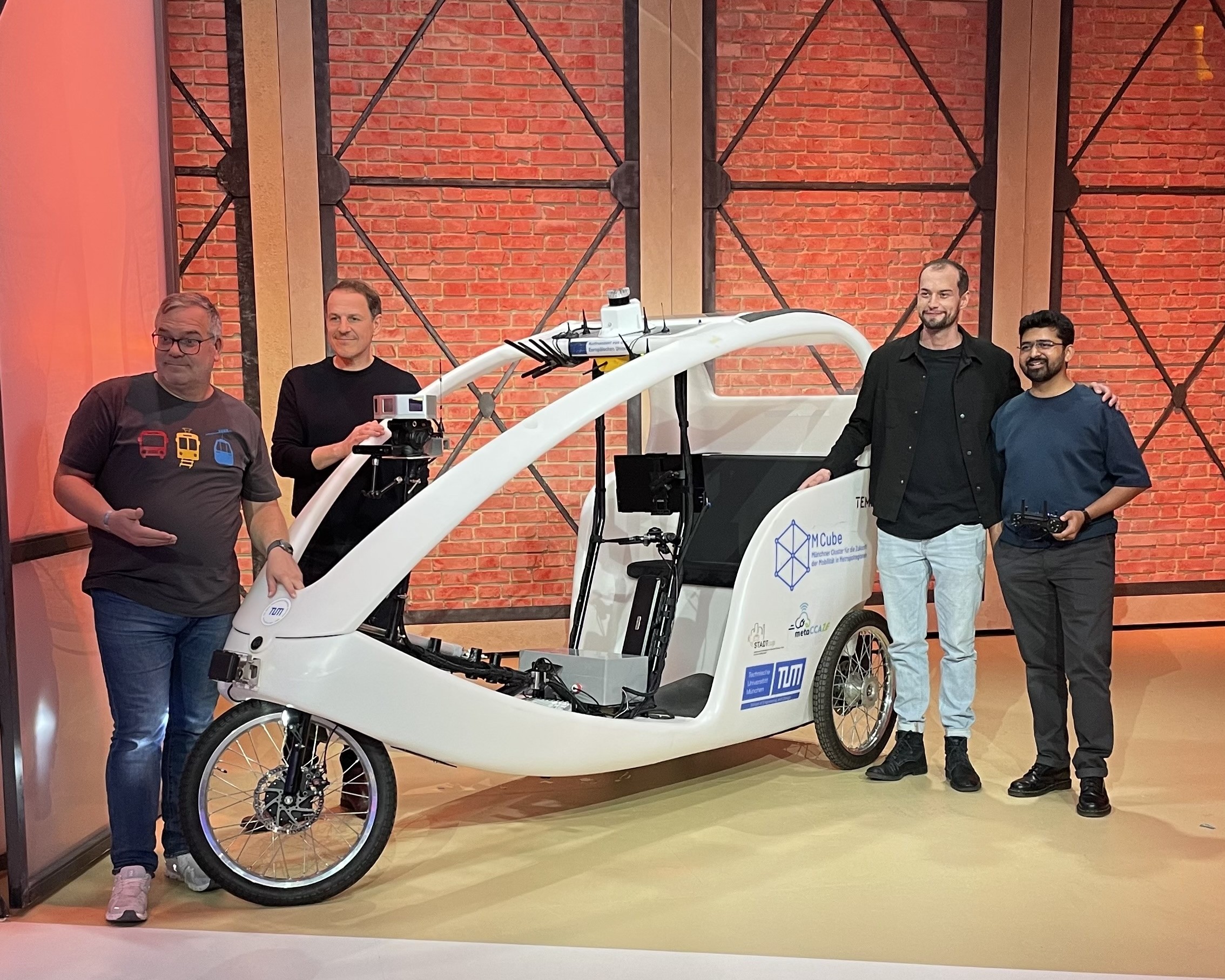
At the Chair of Traffic Engineering and Control of the Technical University of Munich (TUM), researchers are developing a semi-automated cycling rickshaw as a low-cost platform for research and teaching. The vehicle enables students and PhD researchers to gain hands-on experience with automated driving functions and connected mobility applications, covering everything from sensing and control to real-world testing.
Recently, the rickshaw gained national attention when researchers appeared on the popular German TV show 1, 2 oder 3. The team showcased the rickshaw to a young audience, presenting cutting-edge research in an engaging and accessible format: a challenge that proved to be a rewarding experience for everyone involved!
For the metaCCAZE project, the rickshaw serves as a demonstrator vehicle for testing the technologies implemented in the two Munich Living Lab use cases. At the test facility on TUM’s Mobility Innovation Campus, researchers examine how the vehicle could be used in the future for both freight transport (for example, operating within the metaCCAZE XXL-Bike logistics hub) and passenger transport, stopping at the project’s Dynamic Curbside Management (DCM) areas for boarding and alighting.
The development of the rickshaw is made possible thanks to the contributions of the students and researchers who design it, as well as our partners supporting design and integration. It is also made possible through the support of research projects and funding initiatives, including metaCCAZE, but also MCube, STADT:up, and TEMPUS.
TUM’s role in metaCCAZE
TUM contributes to metaCCAZE by leading monitoring and evaluation of Trailblazer Cities and serving on the executive board. Additionally, it supports Munich’s Living Lab, providing scientific expertise for monitoring, evaluation, and optimisation. The Living Lab focuses on three innovations: multimodal logistics hubs, dynamic curbside management, and small connected/partly-automated vehicles for last-mile transport.
Watch the replay here.