Cities worldwide are witnessing rapid growth in Mobility-on-Demand (MOD) services such as Uber, Lyft, and, increasingly, autonomous fleets like Waymo. While these services promise flexibility and convenience for users, they also raise new challenges for urban traffic management. A familiar concern is congestion caused by empty vehicle trips (i.e., when vehicles travel without passengers between requests). Less attention, however, has been paid to a more local but highly disruptive element: the pick-up and drop-off (PUDO) process itself.
When MOD vehicles stop to load or unload passengers, they may block a traffic lane or interfere with curbside activity. Even brief stops can force surrounding vehicles to slow down or merge, degrading traffic flow, especially on busy urban streets. This raises multiple practical questions for city authorities: How should PUDO processes be regulated? Should dedicated curbside stop areas be provided on certain streets to mitigate congestion? If so, how many and where? Should double-parking stops be forbidden, even if this means that MOD users need to walk to or from nearby streets?
A recently published study addresses these questions from a planner’s perspective. Rather than focusing solely on traffic efficiency, the study frames curbside PUDO planning as a multi-objective optimisation problem reflecting the interests of multiple stakeholders. Three objectives are considered simultaneously:
- Minimising traffic congestion, representing the experience of general road users.
- Reducing walking time for MOD users, capturing service quality and convenience.
- Limiting curbside space consumption, reflecting broader societal and urban design considerations, as curbside is a limited and valuable good in today’s cities.
These objectives are inherently in conflict. Allocating more curbside PUDO areas can reduce disruptions to traffic but consumes scarce public space. Restricting PUDO activity on busy streets can improve traffic flow but may require passengers to walk further.
To explore these trade-offs, the researchers from the Technical University of Munich developed a modular solution framework that simulates MOD operations and their impacts on traffic congestion, combined with an upper-level optimisation that uses a state-of-the-art metaheuristic (Adaptive Large Neighborhood Search, ALNS) to explore an enormous solution space.
Applied to a small urban network, the model reveals several policy-relevant findings.
- First, when MOD usage levels are low, dedicated curbside PUDO areas offer only marginal benefits. In such contexts, the disruption caused by occasional stops does not justify reallocating curb space.
- The picture changes as MOD demand increases. At higher MOD shares, even a limited number of well-placed PUDO zones can significantly improve overall traffic conditions, allowing vehicles to move more smoothly through the network.
- Crucially, the analysis shows that more infrastructure is not always better. Beyond a certain point, adding additional curbside PUDO areas yields diminishing returns, with no meaningful further reductions in congestion.
- Finally, the results suggest that on streets with very high traffic volumes, banning PUDO activity altogether may be the most efficient option. In these cases, asking MOD users to walk short distances to quieter side streets leads to overall travel-time savings that outweigh the inconvenience of walking.
The central message of the study is that curbside management for MOD services should be selective, spatially differentiated, and data-driven. Cities can benefit from identifying specific streets where dedicated PUDO areas deliver clear system-wide benefits, while restricting stops on streets where traffic impacts are disproportionate.
For projects like metaCCAZE, which explore dynamic curbside management as part of the transition to connected, automated, and zero-emission mobility, these findings offer a transferable methodological foundation. While the current focus is on logistics vehicles in Munich’s pilot, the framework is equally applicable to passenger-focused MOD services as their adoption continues to grow.
As cities grapple with competing demands on limited curbside space, this research underscores that successful regulation is not just about accommodating new mobility services, but about integrating them intelligently into the urban transport system as a whole.
Read the full paper
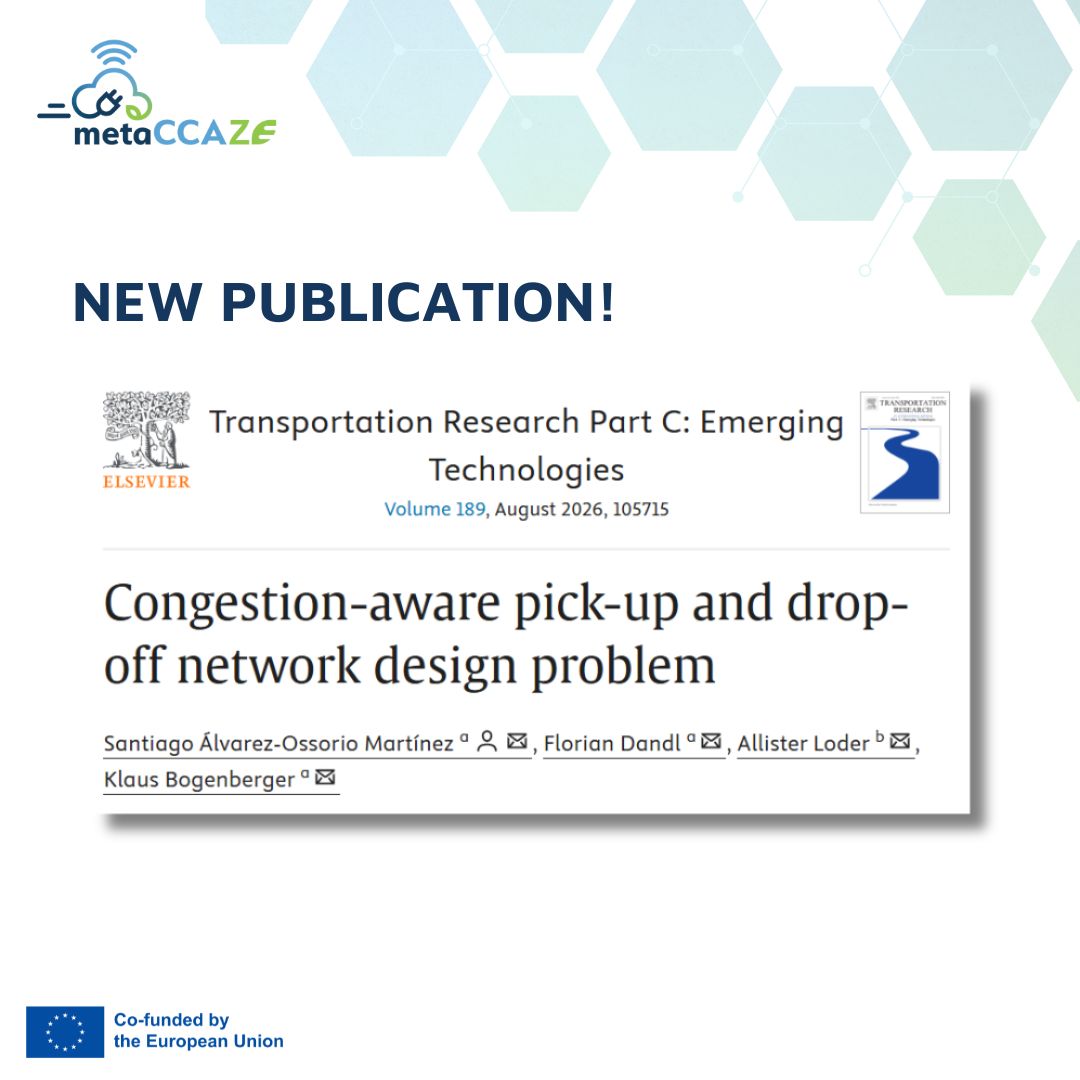
Álvarez-Ossorio Martínez, S., Dandl, F., Loder, A., Bogenberger, K. (2026). Congestion-aware pick-up and drop-off network design problem. Transportation Research,
Volume 189. https://doi.org/10.1016/j.trc.2026.105715.
TUM’s role in metaCCAZE
TUM contributes to metaCCAZE by leading monitoring and evaluation of Trailblazer Cities (Task 3.6) and serving on the executive board. Additionally, it supports Munich’s Living Lab, providing scientific expertise for monitoring, evaluation, and optimisation. The Living Lab focuses on three innovations: multimodal logistics hubs, dynamic curbside management, and small connected/partly-automated vehicles for last-mile transport.
More about the Living Lab in Munich
Munich plays a key role in metaCCAZE as one of the four Trailblazer Cities, leading the way in bike logistics innovation. The city’s Multimodal Bike Logistics Hub aims to demonstrate how cargo bikes can become a viable alternative to traditional delivery vehicles, reducing congestion and emissions in urban areas. In metaCCAZE, the City of Munich is cooperating with several partners, including the Technical University of Munich, Stadtraum, B4B Logistics, Smart City System Parking Solutions GmbH and DB Schenker. Learn more about Munich’s role as a Trailblazer City Munich here.
Access TUM’s and all metaCCAZE scientific publications here.