As cities transition towards sustainable micro-mobilities, they also experience a sharp rise of traffic incidents involving speeding eBikes and eScooters. A paramount and urgent question emerges for local and regional governments: what measures can help curb this sudden surge of incidents involving micro-mobilities? Over the past decade, the Townmaking Institute has been working with the industry and governments to determine all of the possible options to address better micro-mobility safety integrally.
Can riders respond to more than “carrots and sticks”?
One way to dimension eBike and eScooter safety considers societal motivations for safe traffic behaviour.
Can urban authorities appeal to the societal and civic responsibility of urban riders? Can riders understand their societal responsibilities for appropriate speeds in areas like schools or parks without resorting to rewarding them for good behaviour, or threatening them with negative consequences? This helps generate policy instruments that transcend “carrots and sticks” targeted towards individuals, or extrinsic controls that either incentivise through personal benefits or threaten with personal penalties.
Two intrinsic motivators in the Vondelpark
Two of the measures implemented by the Townmaking Institute in Amsterdam‘s Vondelpark focus on intrinsic societal motivators. The Vondelpark is a pedestrian-first zone, prioritising walkers, runners, dog-walkers, and children. A lot of cyclists and eBike-riders passing through the park tend not to be aware of this fact, treating the space like a bicycle highway. The first of the two measures indicates the presence of children at specific places like the two entrances of the Vondelpark which house a daycare centre and a playground. The second indicates the presence of free-roaming dogs, one of the few places in the City where dogs otherwise cooped up in small apartments or crowded streets can run about without a leash.
Positive feedback with conditions
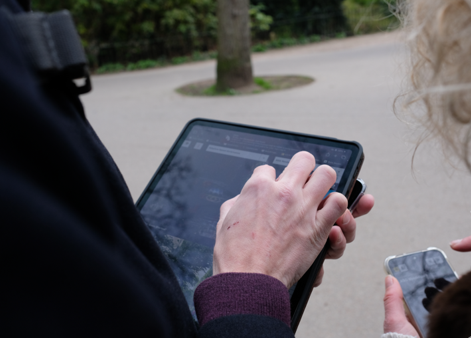
In initial tests in April 2023, riders responded positively, one remarking, “I had an eye on the speed, which said 20 kmph, which doesn’t feel too fast, until I saw the nudge that there were kids playing here, and I should be careful. I immediately slowed down, but of course, this only works if there really are kids there. Otherwise, I would ignore the nudge.”This initial feedback helped generate the solidarity to further explore this option with the municipal council, and led to further working on this option within the metaCCAZE project.
Our systems are only as good as what people make themselves.
The possibility that an intrinsic societal motivator presents a novel approach to urban transport controls and traffic management. In our work in the Vondelpark, careful attention is being paid to ensure that the nudges accurately reflect the realities on the ground. To achieve this, we systematically engage field workers present in the park to understand possibilities of how they can actively contribute towards shaping accurate park conditions together. As a principle, we strictly provide a knowledge-based ecosystem that relies on human contribution without any surveillance technology or artificial intelligence. This principle presents several challenges of its own, such as changes in the roles and responsibilities of field workers to treat them as knowledge workers. Another challenge revolves around progressively educating riders on the novel language, helping them understand signage in a more empathetic light, and governance taking a more empowering role. Finally, it also requires the introduction of new policy instruments that transcend extrinsic “carrots and sticks”, and incorporate intrinsic approaches. Despite the many challenges, some which run counter to prevalent automation trends, the recognition that such an approach empowers and trusts people makes this a worthwhile goal. The principle emphasises that our systems are only as good as what people make by themselves, and when they stop participating actively in such systems that connect people together, they stop knowing them. In an era where we increasingly rely on technology that may not be sovereign or easily governable, perhaps the return to this simple principle can strengthen our societies.
Is your city facing similar incidents with micro-mobilities, and can intrinsic motivators help?
As we actively progress in realizing nudging behaviour, our active engagement with field workers provides us with continuous insights on expanding our work beyond the Vondelpark to other areas of Amsterdam. And eventually, we hope we can engage with other cities in Europe facing the same dilemmas.
About the author:
Indranil Bhattacharya leads the Digital Society workstream in Townmaking. He has fulfilled a variety of Product Engineering roles for almost thirty years, from staff engineer to leadership positions in Fortune100 companies in telecommunications, transport, healthcare, retail, manufacturing, and energy. In parallel to helping the leading corporations in Europe develop products, he has also worked on developing societal assets for more than twenty years. Between 2006 to 2016, these societal initiatives ranged from a peer-to-peer logistics network for helping independent farmers develop their own supply chains direct to homes and restaurants, to a retail network of independent shops. Since 2016, these efforts were consolidated into the Townmaking Institute to help develop societal initiatives that are sovereign, speculation-free, and environmentally-grounded. Indranil specialises in semantic intelligent systems using a knowledge engineering methodology (Embodied Making), which is currently applied for the development of food, transport, and energy systems.