Across metaCCAZE’s Living Labs, cities are running very different experiments on the same underlying question: how much of a mobility problem can be solved by giving people better information, before reaching for new rules or new infrastructure. Malta is exploring that question at the level of policy for autonomous transport. Finland is exploring it at the scale of an entire autonomous public transport system. Munich is exploring it at street level, on a stretch of pavement most people never think about: the loading zone.
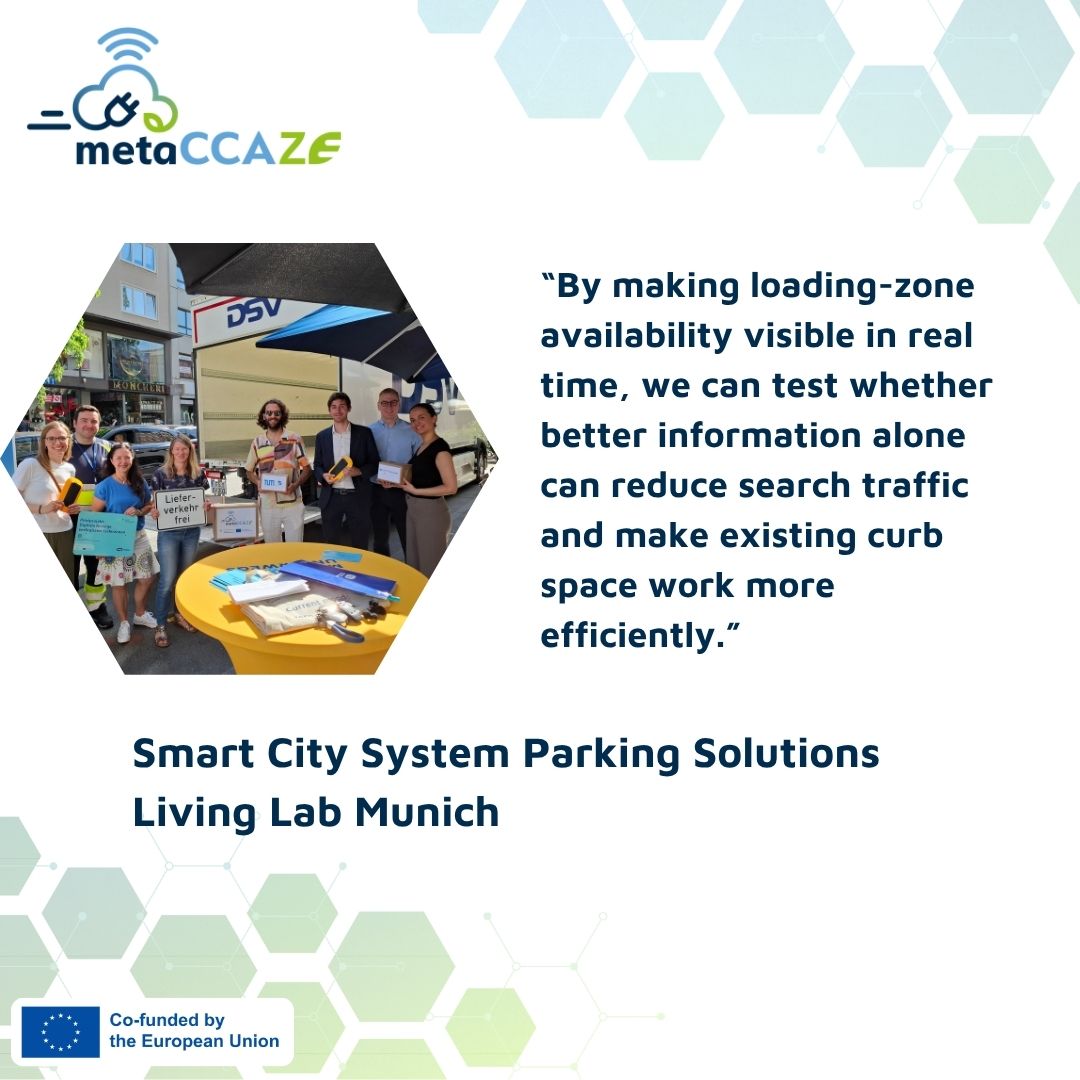
Curb space for deliveries in Munich’s Altstadt has always run on a kind of honour system, backed up by enforcement that can’t be everywhere at once. A zone gets marked, and it works until someone parks in it who shouldn’t, at which point the next delivery van has nowhere to go and either circles the block or blocks a lane instead. In June 2026, the city decided to test a different lever. Mayor Dominik Krause and Mobility Officer Georg Dunkel, together with Annette Hilpert from the Chamber of Commerce for Munich and Upper Bavaria (IHK), opened the public testing phase of “Digitalisation of Delivery Zones,” a pilot covering 21 zones in the Altstadt and the streets around Fraunhoferstraße in Isarvorstadt.
Sensors installed by technology partner Smart City System report occupancy on each zone as it happens, and that feed goes into mo2B, a free app built by Stadtraum that shows a driver which zone is actually open before they arrive rather than after.
What makes this a useful Living Lab case is what it deliberately leaves out. No zone was added, resized or relocated. The infrastructure is exactly what it was before the pilot started. If occupancy conflicts drop anyway, that tells the project something specific: that a meaningful share of curb-space misuse in dense city centres comes down to drivers not knowing what’s free, not to a genuine shortage of space.
The public testing phase runs through the coming months. The city and the IHK are tracking two things in particular: whether illegal use of the marked zones falls, and whether the search traffic caused by drivers looking for an open spot falls with it. Whatever those numbers show will decide whether the 21-zone pilot becomes something larger.
More about the Living Lab in Munich
Munich plays a key role in metaCCAZE as one of the four Trailblazer Cities, leading the way in bike logistics innovation. The city’s Multimodal Bike Logistics Hub aims to demonstrate how cargo bikes can become a viable alternative to traditional delivery vehicles, reducing congestion and emissions in urban areas. In metaCCAZE, the City of Munich is cooperating with several partners, including the Technical University of Munich, Stadtraum, B4B Logistics, Smart City System Parking Solutions GmbH and DB Schenker. Learn more about Munich’s role as a Trailblazer City Munich here.