Amsterdam is a city that likes to experiment. New mobility concepts, citizen initiatives, pilots on the canals and in the streets. The energy is there. What’s harder is knowing whether any of it actually works, and whether it could work somewhere else too.
That question is essentially what Argaleo does for a living. We build digital twins: platforms that pull together data from different sources, connect models, and give cities a shared view of what’s happening across their streets, neighbourhoods and transport systems. Not as a one-off snapshot, but as something living that updates as the city moves.
In metaCCAZE, Amsterdam’s living lab is running several mobility pilots simultaneously. Our role is to make sure those pilots don’t exist in isolation. We connect the underlying data streams, link the models that different partners are building, and create a shared environment where you can actually see what’s changing and what isn’t. Are the interventions having the impact they should? Where are the bottlenecks? And if something works here, what would it take to roll it out at scale, or move it to another city?
That last question is one we find particularly interesting. A pilot that works in one neighbourhood is not automatically a solution. Understanding the conditions that made it work, and being able to visualise those conditions for a different context, is where the real value sits. It’s also where digital twins tend to be underused in innovation projects.
We’re a small company from Brabant that has spent the past years building tools for exactly this kind of work, in cities across the Netherlands. Being part of a European consortium like metaCCAZE pushes that work further, and connects it to a wider set of questions about what liveable, zero-emission cities actually need to function.
Amsterdam is a good place to ask those questions. Complicated enough to be realistic, curious enough to keep trying.
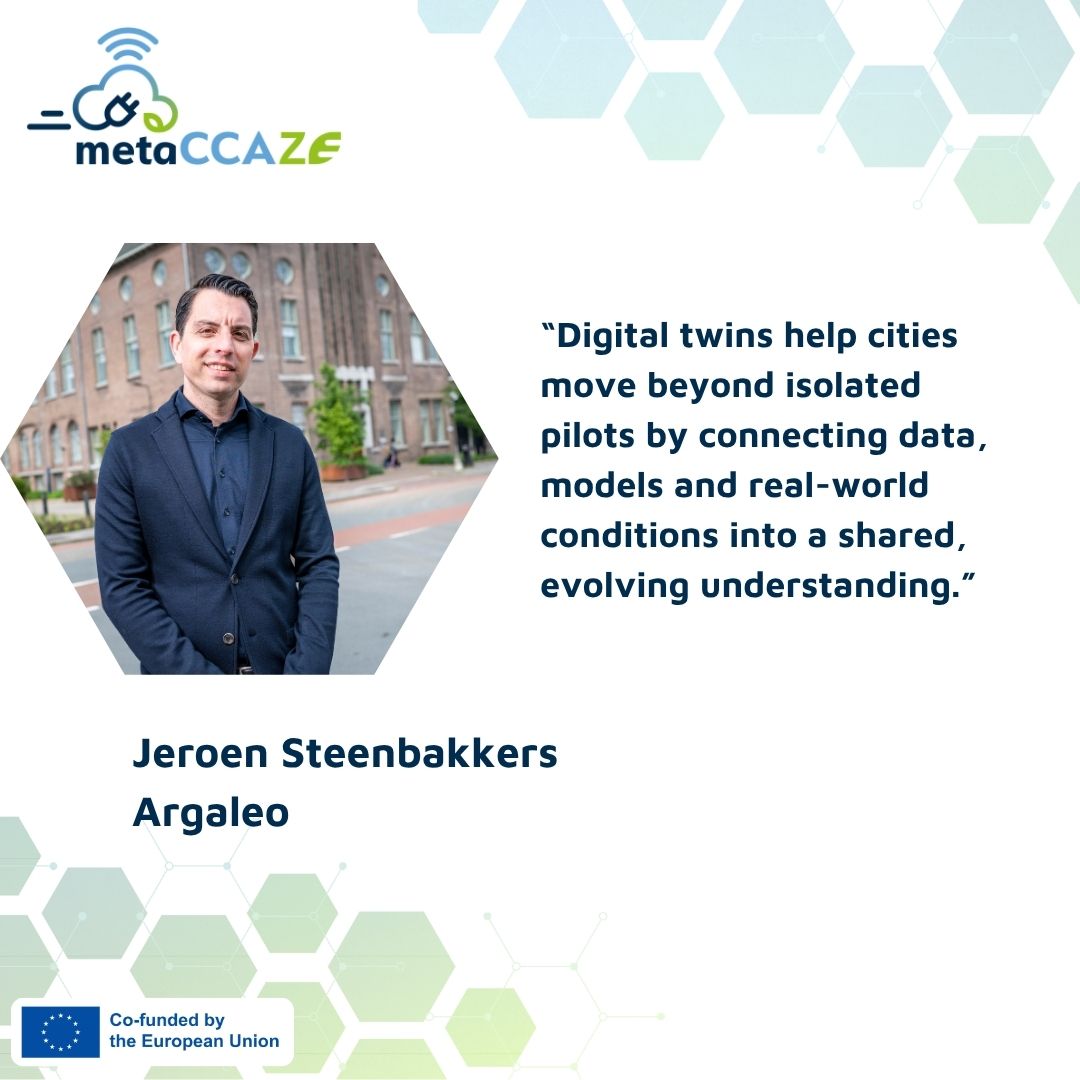
By Jeroen Steenbakkers, Argaleo