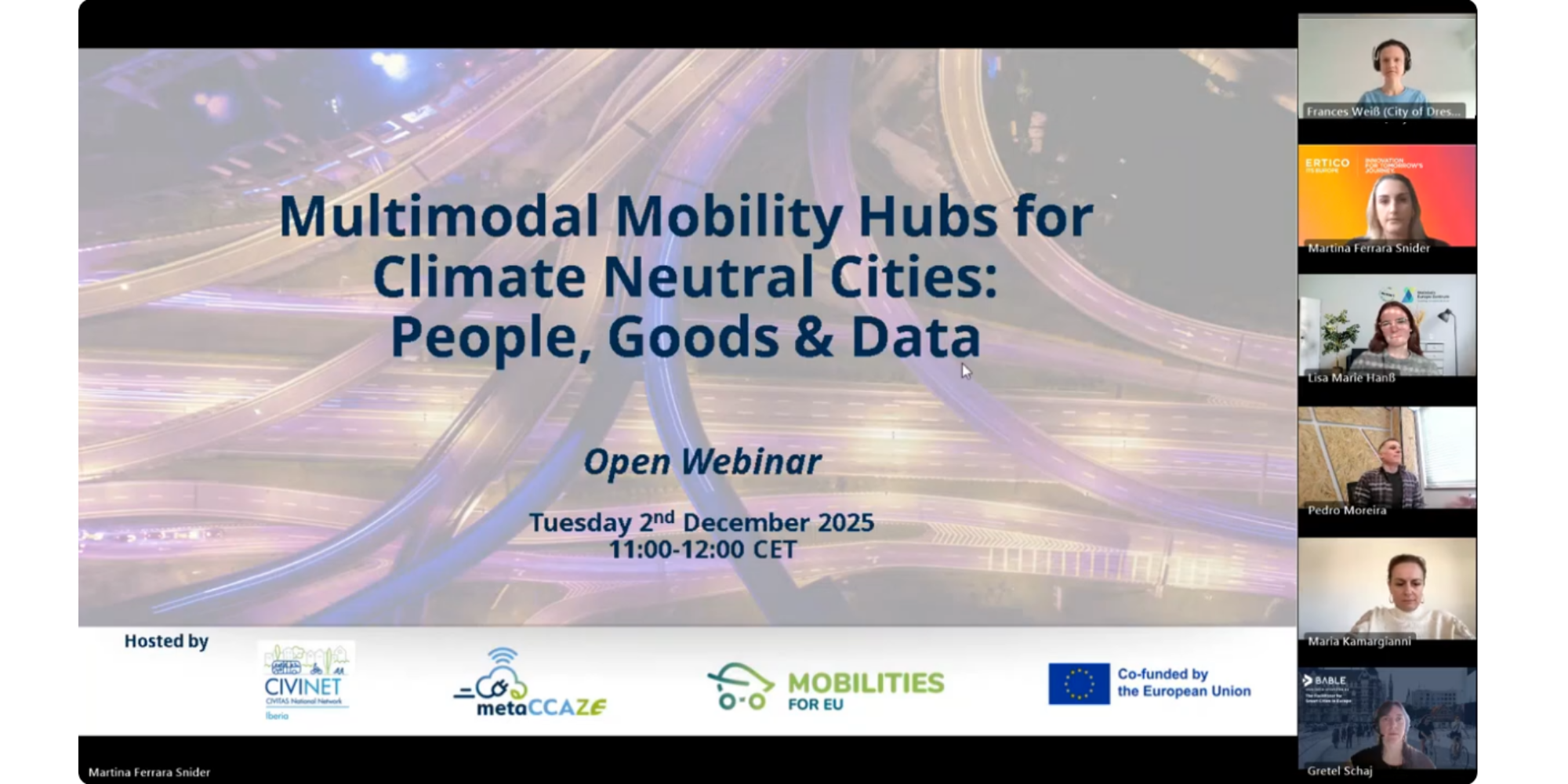
On 2 December 2025, metaCCAZE co-hosted the webinar “Multimodal Mobility Hubs for Climate-Neutral Cities: People, Goods & Data”, bringing together mobility experts and city representatives from MOBILITIES FOR EU and CIVINET Iberia to explore how multimodal hubs can accelerate Europe’s transition towards cleaner, more efficient urban mobility systems.
For metaCCAZE, mobility hubs are key infrastructures that enable seamless connection between public transport, shared mobility, active travel, and automated services. They support the project’s wider mission to deploy smart and shared zero-emission mobility solutions across European cities and reduce reliance on private cars.
Insights from three European cities
The webinar highlighted practical experiences from three cities: Limassol in Cyprus, Braga in Portugal and Dresden in Germany.
Limassol (Cyprus): planning for integration
Prof. Maria Kamargianni from MaaSLab presented the planning process behind the first multimodal mobility hub in Limassol, one of metaCCAZE’s Trailblazer Cities. Currently, around 92% of trips in Limassol are made by private cars.
The planned hub will allow residents from outside the city to park and continue their journeys using on-demand buses, public transport, taxis, car-sharing, bikes, and electric buses. The location was carefully selected after assessing 14 potential sites, with the final choice offering strong connectivity to the highway, existing cycling infrastructure, and future bus lines.
Going beyond a simple park-and-ride facility, the hub is being designed as a high-quality public space, with amenities such as trees, benches, toilets, ATMs, and small retail services to improve the user experience and reduce the negative effects of waiting and transfer times. The business model combines operational costs with revenues from parking, rentals, services, and advertising. The hub is planned to include 300 parking spaces, along with areas for taxis, bikes, and electric buses. Final designs are expected in 2026, with delivery to citizens planned for 2027.
Dresden (Germany): MOBIpunkte as a long-term success story
Frances Weiß from the City of Dresden shared why the city’s MOBIpunkte are considered a durable success story. Dresden already benefits from a strong culture of multimodal travel, and the city has further accelerated the shift toward ecomobility through the creation of a comprehensive “MOBI World”: an integrated ecosystem of passenger transport services.
MOBIpunkte are strategically located near tram and bus stops to enable easy transfers between modes. They combine car sharing, bike and cargo-bike sharing, charging stations for e-bikes and e-cars, public air pumps, and Wi-Fi. They are coordinated through a dedicated taskforce led by the city’s Office for Urban and Mobility Planning and brings together both public and private partners.
Since the first MOBIpunkt was launched in 2018, the network has grown to 68 Punkte, with more than 85 planned by 2027. Today, the system includes 182 car-sharing points (81 of them electric), supporting the reduction of approximately 1,500 private cars, as well as a large bike-sharing system with cargo bikes and thousands of daily rentals, demonstrating tangible impacts on sustainable urban mobility.
Braga (Portugal): strategic planning for urban logistics hubs
Pedro Moreira from the Municipality of Braga presented Braga’s approach to strategic planning for optimised urban logistics hub locations. With around 210,000 residents, Braga is a highly dynamic city that is actively rethinking urban logistics to improve efficiency, reduce congestion, and support sustainable mobility.
The city’s strategy includes the development of micro-logistics solutions in the historic centre, regulation of loading and unloading operations, traffic calming measures, and the integration of park-and-ride facilities. Several projects support this vision. Standtrack for example enables full parcel traceability across logistics stakeholders, eliminating re-labelling and improving interoperability. NIMBLE focuses on optimising last-mile delivery routes through digital tools, while SOCILIBRE combines social inclusion with digital logistics by training vulnerable groups for last-mile services.
Driving the transition to climate-neutral cities
Together, the three city cases illustrated how multimodal mobility hubs and logistics hubs can support climate-neutral urban development, by integrating transport modes, improving the user experience, strengthening public-private cooperation, and combining infrastructure with digital and social innovation.
Missed the live session or would like to revisit the discussions? You can now watch the full webinar recording below.
You are currently viewing a placeholder content from YouTube. To access the actual content, click the button below. Please note that doing so will share data with third-party providers.
More Information