The City of Action, where automated mobility moves from vision to operation
The Tampere Living Lab acts as a trailblazer city within the metaCCAZE project, funded by the European Union. The Living Lab is implemented through close cooperation between Tampere University, the City of Tampere, and industry partner Remoted. Tampere builds on a strong track record in automated mobility, having already gained practical experience through earlier automated bus deployments. These earlier activities provided valuable insights into safety management, stakeholder coordination, and public acceptance, which directly informed the metaCCAZE use case.
Within metaCCAZE, the Tampere use case focuses on a tram feeder service supported by an advanced Remote Control Centre and automated charging infrastructure. The service connects residential areas with the tram network and is designed to operate as part of Tampere’s public transport system rather than as a stand-alone demonstration. From the beginning, the emphasis has been on operational realism and long-term integration.
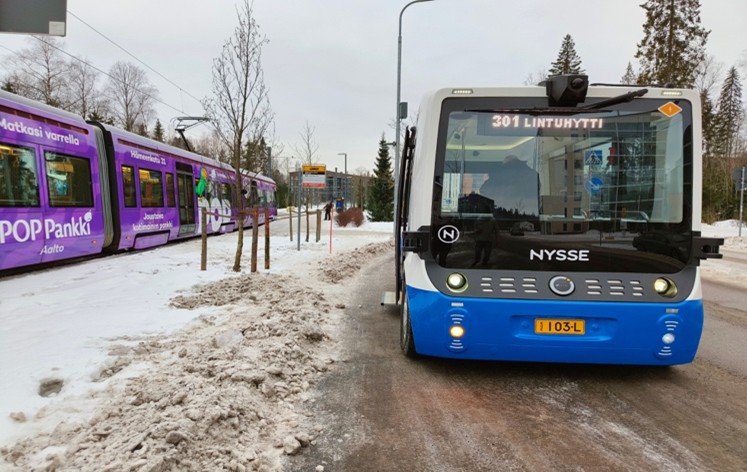
Extensive planning and preparation were completed well before the vehicle arrived in Tampere. This included procuring a vehicle compliant with operational and regulatory requirements, selecting a pilot route based on demand and safety considerations, and preparing integration with the NYSSE regional public transport system. In parallel, remote operation systems were prepared to enable real-time monitoring, supervision, and intervention during automated vehicle operations.
Following vehicle delivery, the focus shifted to final operational setup. The vehicle was upgraded with additional cameras, automated passenger counting, two-way communication, and ticketing systems to support commercial operation. At this stage, both technical readiness and passenger-facing aspects—such as vehicle appearance and user perception—were considered, as these differ from purely technical requirements. These enhancements also enable future demonstrations of higher levels of automation by improving perception capabilities and system redundancy.
L3-level automated operations commenced on 17 November 2025 in the route Lintuhytti – Hervantajarvi. The service operates under supervised automation, with a safety operator remaining onboard the vehicle, while additional oversight is provided through remote supervision. This approach reflects current regulatory and technical frameworks and allows automated driving functions to be tested and validated under real public transport conditions.
The tram feeder service is fully integrated into Tampere’s public transport ecosystem. Passengers can plan their journeys and access the service using the NYSSE public transport application and existing ticketing system, ensuring a seamless experience consistent with other public transport services. This integration reinforces the role of automated vehicles as part of everyday mobility in the city. The service currently operates at a frequency of two trips per hour, with plans to increase to four trips per hour in spring, subject to operational performance and demand. Schedule information is available through the public transport journey planner, ensuring transparency and accessibility for passengers (https://www.nysse.fi/matkan-suunnittelu/linjat/301.html).
Automated charging is a key component of the Tampere use case. The project has adopted a robotic arm–based charging solution that has performed well in laboratory environments. During practical operation, particularly with repetitive charging cycles, some challenges have been encountered, and these are currently being addressed. In addition, implementation depends on permits and approvals from the vehicle manufacturer for this charging approach. Despite these dependencies, the charging infrastructure provides a strong basis for continued development and future operational use.
Early operational performance data collected by the end of January 2026 indicate stable and reliable service. During this period, the shuttle operated on 71days and completed a growing number of 1995 trips, serving 1632 passengers with no safety-critical incidents recorded. The vehicle accumulated 2707, 214 operational kilometres and hours, with a high share of trips operated in automated mode. Energy consumption and charging performance were monitored closely, providing important input for ongoing optimization.
Remote monitoring and oversight play a central role in daily operations. Live camera feeds are monitored from the Remote Control Centre, providing an independent situational awareness layer that complements vehicle provider’s onboard systems. In a later phase, a stakeholder observation layer is planned, offering secure, read-only access to selected live feeds for project partners and researchers while ensuring safety and data protection.
Data collection and user engagement activities support evaluation and learning within metaCCAZE. A pre-pilot survey was conducted using postal and online methods, targeting local residents and achieving a considerable response rate. Passenger surveys were carried out in January using both in-person interviews and online questionnaires, focusing on service perception, accessibility, travel behaviour, safety, trust, and acceptance. A follow-up survey is planned for a later phase, including operations without an onboard safety operator once additional vehicles are deployed.
Unlike traditional pilots, the Tampere deployment is embedded within the public transport system and operates as a routine service rather than a time-limited demonstration. By running on a fixed route, using existing ticketing and journey planning systems, and serving everyday passengers, the deployment generates practical experience under real operating conditions. This provides regulators with evidence on supervised automation in practice, supports procurement models that focus on commercial operational services rather than experimental vehicles, and allows public acceptance to be assessed through repeated, everyday use instead of one-off trials. Together, these elements mark an important step toward integrating automated mobility into regular transport services.
More about metaCCAZE Trailblazer City, Tampere
Tampere plays a leading role in metaCCAZE by pioneering automated mobility. The goal is to move safety operators from inside vehicles to remote centres, enabling monitoring of multiple AI-driven vehicles for greater efficiency and reduced costs. Read more here.