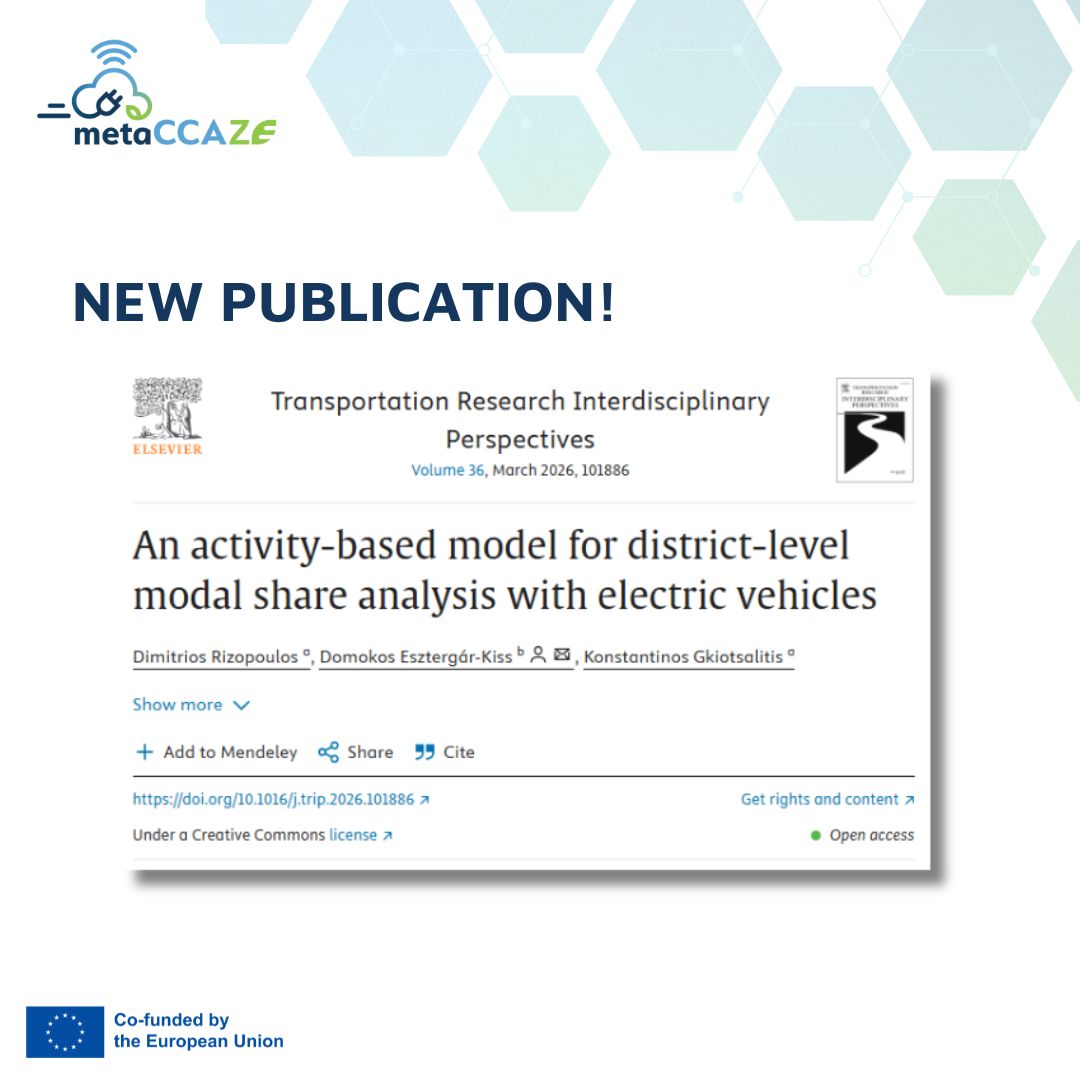
Cities aim for cleaner transport, but it’s hard to see how electric cars affect travel patterns, neighbourhood by neighbourhood. The National Technical University of Athens (NTUA) and Budapest University of Technology and Economics (BME) have published a new scientific paper in Transportation Research Interdisciplinary Perspectives that tackles this issue.
The new study proposes a practical way to forecast how shifting drivers from petrol/diesel cars to electric vehicles (EVs) could change travel patterns and emissions across different parts of a city. In the case study presented, the researchers build an activity-based model that starts from what people actually do in a day (home, work, shopping, leisure) and then “re-plans” those daily travel chains under different EV-adoption scenarios. Crucially, the approach does not treat travel as a single trip from A to B. It models scheduling and routing together, including the extra detours and time constraints that come with EV charging and the uneven spread of charging stations across districts.
What makes this work stand out is its integration of public and personal transport scheduling research in one framework. The model combines public transport timetables with personal vehicle routing (including EV charging sub-tours), so the same “daily plan” can be evaluated consistently across modes, rather than comparing apples (car trips) to oranges (transit service averages). In simulations where EVs reach 20% of the car share, average CO₂-equivalent emissions fall city-wide by about 18.5%, but average travel distance rises by about 8.2% because EV users sometimes need to detour for charging, especially in areas with weaker network connectivity or fewer chargers.
The key finding is that EV benefits are real but uneven: emissions drop everywhere, in some districts by over 20%, yet distance increases tend to be larger in less dense areas with poorer charging coverage. In other words, electrification helps the climate targets, but without well-planned charging infrastructure (and an honest look at how people actually schedule their days), it can quietly add extra travel.
Read the full paper
Rizopoulos, D., Esztergár-Kiss, D., & Gkiotsalitis, K. (2026). An activity-based model for district-level modal share analysis with electric vehicles. In Transportation Research Interdisciplinary Perspectives. metaCCAZE. Horizon Europe Grant No. 101139678. https://doi.org/10.1016/j.trip.2026.101886
NTUA’s role in metaCCAZE
The Department of Transportation Planning and Engineering at the National Technical University of Athens (NTUA) is a globally recognised center of excellence in transport research and innovation. Its mission is to educate transport engineers and advance science in transport planning and engineering. In metaCCAZE, NTUA is the technical coordinator and leads WP2, focused on developing an open, smart toolkit that integrates electrification, automation, and connectivity to support zero-emission shared mobility systems.
BME’s Role in the Project
Budapest University of Technology and Economics (BME), founded in 1782, is one of Central Europe’s leading technical universities with an internationally recognised profile in engineering and applied sciences. In metaCCAZE, BME’s Department of Transport Technology and Economics co-organises the Living Lab in Miskolc, Hungary, and facilitates stakeholder cooperation. Its core tasks include developing methods for extended journey planner functionalities, designing and analysing user surveys on travel behaviour and acceptance of new mobility solutions, assessing potential impacts, and leading co-creation activities to ensure an effective pilot implementation.
Access all metaCCAZE scientific publications here.