Poissy is a municipality in the Yvelines department (Paris Region) with a population of almost 40K and a host of several tech companies and auto manufacturers.
The living lab will demonstrate intelligent roads, connected vehicles and utilisation of drones.
The Yvelines department manages the entire demonstration process, supports the organisation of co-creation activities, co-designs and builds the infrastructure, and promotes smart, on-demand services.
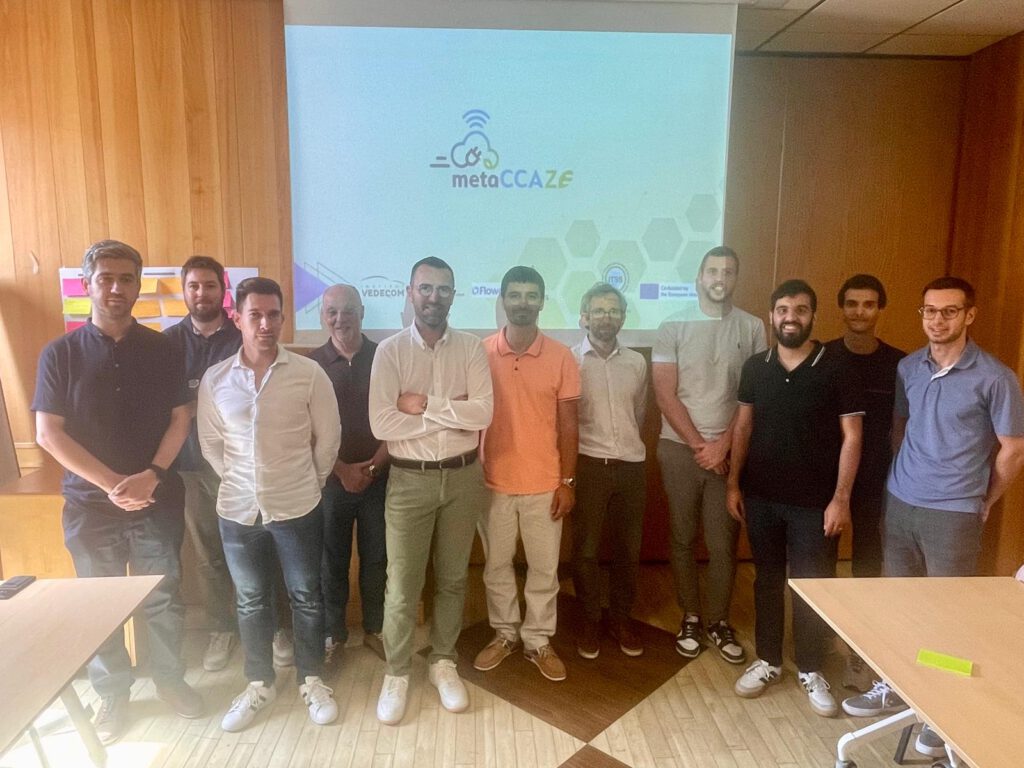
Challenges
Poissy’s rail station is a local mobility hub that attracts and generates a large number of trips (>10M passengers per year) as it offers connection to neighboring areas (14 bus lines) and Paris (2 train lines). In the station vicinity there is congestion despite a series of roundabouts that were added in the past as a congestion (and safety) countermeasure. The use of ITS and more advanced traffic management systems are essential for the efficient operation of the hub. Especially:
- smoothing traffic flow through V2X technology: communication with traffic lights, V2V at intersections.
- synchronisation of vehicles arrivals to other public transport stations.
- evaluation of impacts on traffic performances, security, air quality and acceptability.
Use cases
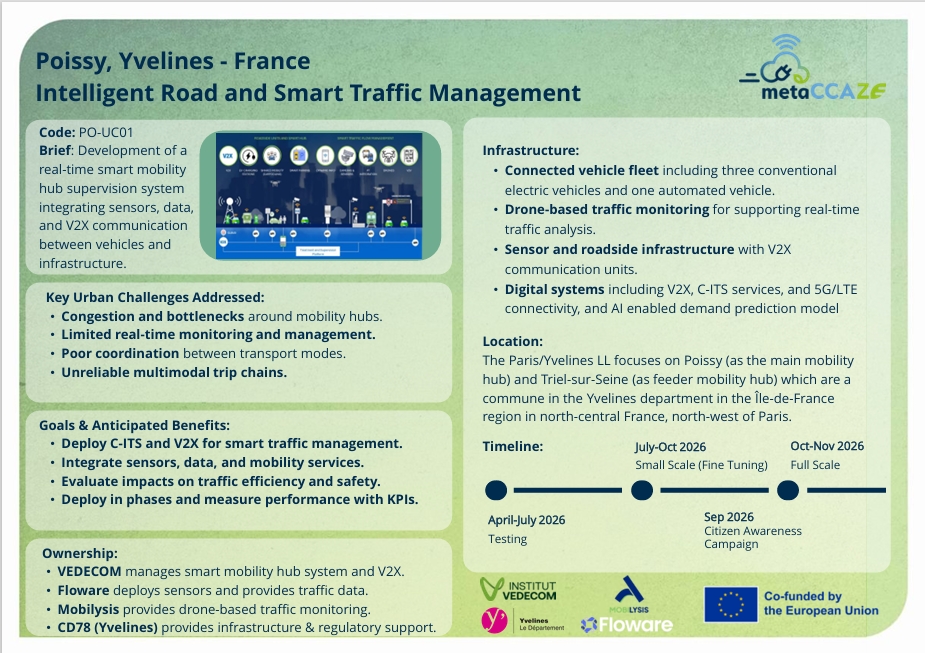
Intelligent Road and Smart Traffic Management
Development of a real-time smart mobility hub supervision system integrating sensors, data and V2X communication between vehicles and infrastructure.
Read more here.
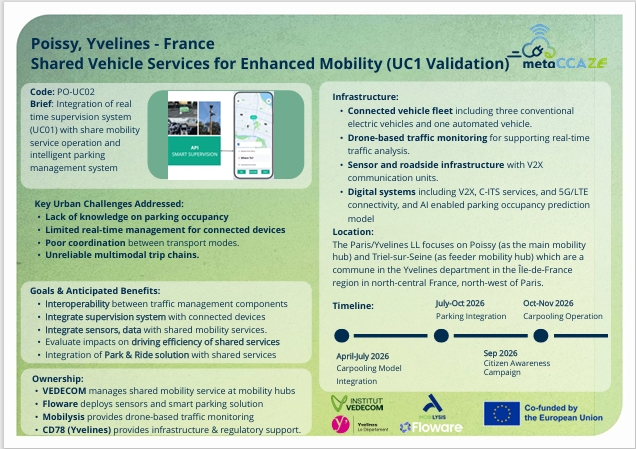
Shared Vehicle Services for Enhanced Mobility (UC01 Validation)
Integration of a real time supervision system (UC01) with shared mobility service operation and intelligent parking management system.
Read more here.
Role of the living lab in metaCCAZE
This living lab aligns with metaCCAZE’s project to implement smart shared and zero-emission mobility systems and pave the way towards climate neutral, safe and smart EU cities as the living lab aims to improve throughput at roundabouts, reduce delays and conflicts, improve air quality.
Beyond the project, the living lab will allow to develop AI-models based on city data, V2I and V2V protocols.
Living Lab partners



Contact
- Clément Papon
- c.papon@yvelines.fr