Last month, for the European Mobility Week, the city of Milan organised the first edition of MOBIDAYS, a renewed format to engage citizens, academia, private companies, public entities to share the city’s path towards sustainable and accessible mobility.
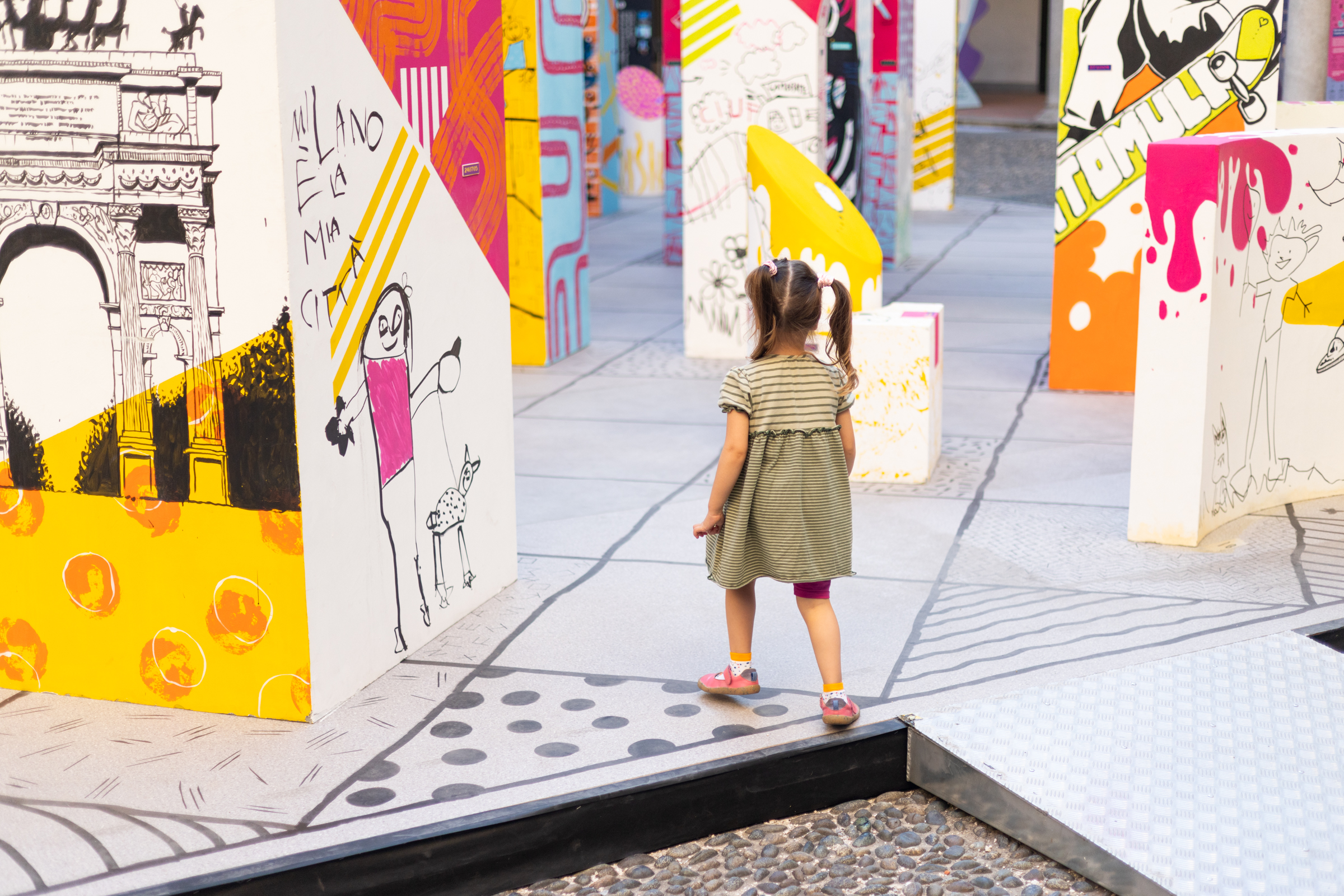
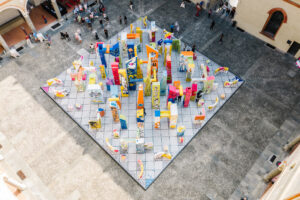
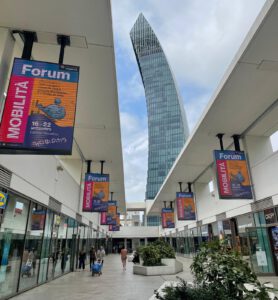
The event (16-22 september 2026) took place in the Cortile della Rocchetta, the inner bailey of Sforza Castle, in the heart of the city. The bailey was set up with an exhibition, an art installation and a presentation area with a stage and chairs for the public.
The exhibition was centered on the theme of mobility and its related topics, such as environment, road safety, public spaces, logistics, etc. The first part presented data about the current state of the city and the achievements in the last years: new M4 metro line, new cycle routes, reclaimed public space from parked vehicles and shared mobility. It also presents the current challenges in governing the city mobility, such as the large number of people who would switch to car use if the traffic decreased, effectively creating a ‘buffer’ effect for the public policies aimed at reducing car use. The second part of the exhibition presents ‘Milano MOBIle’: , the acceleration in reclaiming public spaces, improving the speed of public transport, developing efficient on-demand service, taking action on urban heat islands, empowering the 15-minutes city make the city fully indipendent from car use.
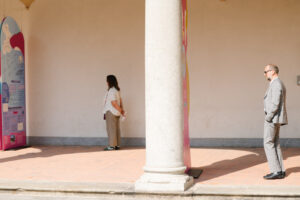
The art installation in the center of the bailey was the stage of a labyrinth-like game supported by a webapp which contained instructions on one’s own path. The scope was to prove that other people playing the game or vising the installation would limit one’s movement, teaching that the mobility behaviour of the whole city is the consequence of the different needs and choices of each individual person. It proved very popular among tourists and kids, who used it as a playground, and created this ‘congestion’ effect of the ones playing the game, effectively demonstrating the purpose of the installation.

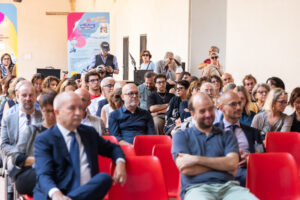
Lastly, the stage area hosted a seven days long program of talks on different themes with a wide range of guests ranging from politicians, urban designers, mobility planners, environmental experts, private companies working in the mobility and technology sectors.
metaCCAZE was the center of a dedicated session, where we presented to the public the innovative on-demand service of the Milan Living Lab, with the collaboration of AMAT, ATPL, TRT, Next and NEMI. The on-demand service will make use of Next’s modular pods and will evaluate the benefits of enabling passenger transfers between different on-demand trips. The resulting impact on overall service performance will be assessed through key performance indicators (KPIs), including waiting times, request fulfilment rates, modal shift, and greenhouse gas emissions reductions. The type of service and the design and functionalities of Next’s pods attracted considerable interest and prompted many questions from visitors. Then, we invited on stage the Mayors of the four municipalities involved in the pilot: Michele Avola (Bellinzago Lombardo), Ilaria Scaccabarozzi (Gorgonzola), Lucia Mantegazza (Gessate) and Alberto Villa (Pessano con Bornago).
The mayors warmly welcomed the pilot deployment in their municipalities, expressing strong enthusiasm for the opportunities it could bring to their communities. They stressed that the themes addressed by the exhibition, such as sustainable mobility, accessibility, and the transition towards more efficient transport systems, are not limited to large urban centres. On the contrary, these challenges are often even more relevant in suburban and peri-urban areas, where lower population density and limited public transport options can make everyday travel more difficult.
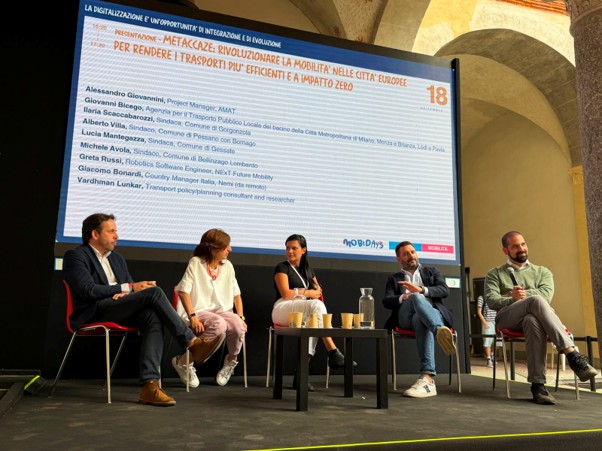
From left to right: Michele Avola (Bellinzago Lombardo), Ilaria Scaccabarozzi (Gorgonzola), Lucia Mantegazza (Gessate) and Alberto Villa (Pessano con Bornago), Giovanni Bicego (ATPL)
The discussion then focused on the specific mobility needs that the new service aims to address within their communities. Among the most frequently mentioned challenges were evening and weekend travel, particularly on Saturdays, access to sports facilities and healthcare services, and connections to destinations that are currently underserved or not covered by fixed-route public transport. The flexibility offered by an on-demand service was recognized as a key advantage, especially for residents who struggle to access essential services through traditional transport options.
The mayors also shared their expectations for the pilot, discussing both the opportunities and the potential challenges associated with the service. On the one hand, they highlighted its potential to improve accessibility, enhance social inclusion, and offer a viable alternative to private car use. The exchange provided valuable insights into the role that innovative demand-responsive transport solutions can play in supporting more sustainable and inclusive mobility in suburban areas and presented the expectations for the pilot which will start in January 2027 and run for 6 months, in the municipalities of Bellinzago Lombardo, Gessate, Gorgonzola and Pessano con Bornago, in the eastern part of the Metropolitan City of Milan. They also identified several key factors that can support the success and long-term sustainability of the service, including strong user adoption, close alignment with local mobility patterns and residents’ expectations, and the potential continuation of the service beyond the pilot phase. In this regard, discussions have already started with the mayors of neighbouring municipalities to explore possible future extensions of the service, with a broader operational area covering additional municipalities.
Authors: Giovanni Bicego (ATPL) & Alessandro Giovannini (AMAT)